The Great Yes, The Great No
William Kentridge

The Great Yes, The Great No is part play, part oratorio, part chamber opera.
William Kentridge’s breathtaking visual inventiveness, particularly linked to the spirit of surrealism, is in dialogue with Nhlanhla Mahlangu’s musical composition, in a dramaturgy combining a ‘Greek choir’, actors and dancers, projections, masks and shadow play. The fertile ground of the Black Paris of the 1940's, the poetics of Martinique, Surrealism and the Négritude movement form the background to the libretto. The Great Yes, The Great No is led by these anti-rational ways of approaching language and image. Finding strange beauty in the unexpected, the uncanny, the disregarded and the unconventional, surrealism has been described as Negritude's creative weapon, and The Great Yes, The Great No captures the poetic and the revolutionary as it gestures towards a more free future possibility.


In 1941, the ship Capitaine Paul Lemerle set sail from Marseille bound for Martinique, carrying passengers escaping the devastation of war. Among them were the writer Anna Seghers, anthropologist Claude Lévi-Strauss, and surrealist pioneer André Breton. In The Great Yes, The Great No, William Kentridge reimagines this real voyage: at its center is Captain Charon—the mythic ferryman of souls—who welcomes an extraordinary assembly of travelers from across time. Alongside Frantz Fanon, the revolutionary psychiatrist and philosopher, come artist Frida Kahlo, poet Aimé Césaire, and sisters Paulette and Jeanne Nardal, key voices of the Négritude movement. United by the charged symbolism of a sea crossing, these figures journey together toward a transformed world.
True to his signature approach, Kentridge weaves together film, drawing, theater, live music, song, dance, and literature to tell this layered story. His performers animate the stage through expressive cardboard portrait masks, while projected images of a model ship thread through the performance’s moving tableaux. History and imagination intersect—Josephine Baker dances alongside Joséphine Bonaparte, and a seven-member women’s chorus gives voice to all those who must rebuild after turmoil and loss. Spoken and sung in eight languages, the work unfolds as a sweeping, polyphonic voyage across art forms and histories.
Kentridge’s practice—spanning the visual arts, opera, and collaborative performance—is rooted in participatory creation and a deep engagement with historical and political narratives. His previous presentations at Berliner Festspiele include the 2016 exhibition NO IT IS! and the installation More Sweetly Play the Dance. That same year, he founded the Centre for the Less Good Idea in Johannesburg, a hub for experimental, collective, and cross-disciplinary artmaking. It is there, through an intensive process of workshops and rehearsal with choral composer and associate director Nhlanhla Mahlangu and associate director Phala Ookeditse Phala, that The Great Yes, The Great No took shape.

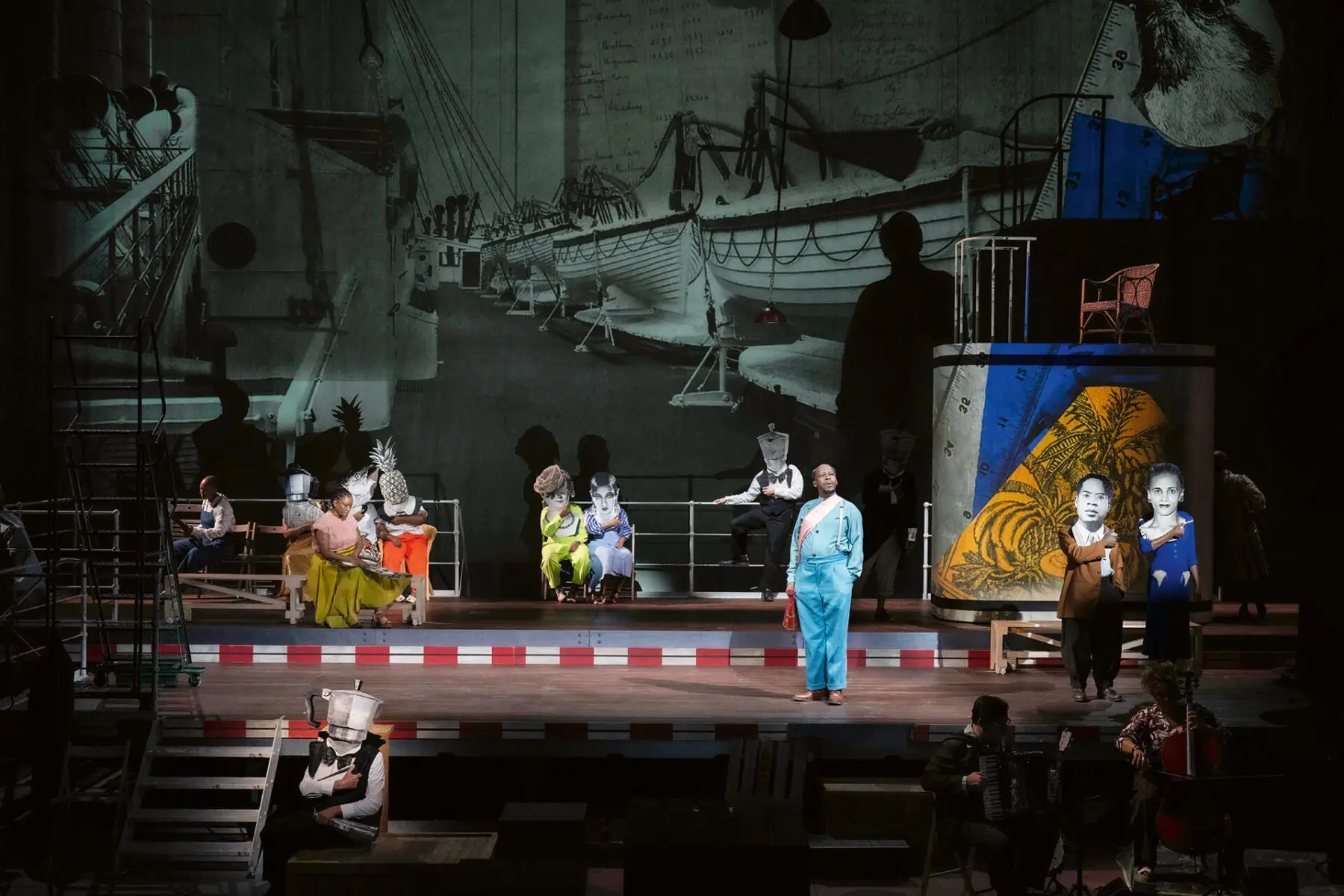
"Riding on the braided currents of poetry, acting, dance, masks, scenography, projections, animation, a nimble four-person band, and a surging seven-member chorus, the work charts a course through deep and swirling waters."
— San Francisco Chronicle
Team
Concept and Director William Kentridge
Associate Director and Choral Composer Nhlanhla Mahlangu
Associate Director Phala O. Phala
Costume Designer Greta Goiris
Set Designer Sabine Theunissen
Music Director Tlale Makhene
Dramaturg Mwenya Kabwe
Lighting Designers Urs Schönebaum and Elena Gui
Projection Editing and Compositing Žana Marović, Janus Fouché, and Joshua Trappler
Cinematographer Duško Marović
Video Control Kim Gunning
Sound Designer Gavan Eckhart
Performers Xolisile Bongwana, Hamilton Dhlamini, William Harding, Neil McCarthy, Tony Miyambo, Nancy Nkusi
Chorus Anathi Conjwa, Asanda Hanabe, Zandile Hlatshwayo, Khokho Madlala, Nokuthula Magubane, Mapule Moloi, Nomathamsanqa Ngoma
Dancers Thulani Chauke, Teresa Phuti Mojela
Musicians Marika Hughes (cello), Nathan Koci (accordion/banjo), Tlale Makhene (percussion), Thandi Ntuli (piano)
Produced by THE OFFICE performing arts + film
A project of the Centre for the Less Good Idea
Toured in partnership with Pomegranate Arts
Lead Commissioner LUMA Foundation, in partnership with the Festival d’Aix-en-Provence
Co-Commissioners Adrienne Arsht Center for the Performing Arts, with lead sponsor support from Adrienne Arsht; Cal Performances; Centre D’art Battat Montreal; and The Wallis
Tour Dates
2025 Festival dei Due mondi di Spoleto, Spoleto (IT) | Ruhrfestspiele, Recklinghausen (GE) | Bergen International Festival, Bergen (NO) | CalPeformances, Berkeley, CA (USA) | The Wallis, Los Angeles, CA (USA) | Adrienne Arsht Center, Miami, FL (USA)
2024 ImpulsTanz, Vienna (AT) | Luma Foundation, Arles (FR) [PREMIERE]
2023 In development
Selected Press Mentions
The New York Times: William Kentridge Reflects on What It Means to Be a South African Artist
UC Berkeley News: William Kentridge’s ‘The Great Yes, The Great No’ is a voyage of chaos and creativity
SF Classical Voice: An Urgent Alternate History Unfolds in William Kentridge’s The Great Yes, The Great No
Los Angeles Times: William Kentridge’s ‘The Great Yes’ at the Wallis: A dazzling meditation on a world out of kilter
San Francisco Chronicle: Dictators and famed artists clash in William Kentridge’s ‘The Great Yes, the Great No’
The Luxembourg Times: A ‘Great Yes’ to Kentridge’s latest piece
Financial Times: The Great Yes, The Great No review — William Kentridge’s operatic tale of fleeing intellectuals